
Compare flood mitigation barrier systems, solutions, and options. Specialized barriers are designed, engineered, and installed to prevent damage from storm surges. Individual barriers are typically components of a larger flood mitigation system, built to protect vulnerable entrances, openings, and full perimeters. Systems use watertight components, controlled deployment capabilities, and reliable sealing mechanisms.
- Hydrostatic Pressure Stability: Solutions stay anchored, resistant, and watertight. Devices are built with interlocking geometrical components, wide bases, and functionality to distribute hydrodynamic loads.
- Balanced Load Management: Defend against horizontal, vertical, and dynamic forces with dedicated products. Select options fabricated with reinforced components, structural ribs, and angled geometry.
- Continuous, Sealed Protection: Create a continuous, uninterrupted line of defense against stormwater. Integrate options with tested compression seals and durable gaskets.
- Predictable, Rapid Deployment: Compact, lightweight, modular, and reusable. Respond fast with hardware & tool-free options.
If your property is located in high-risk coastal or urban areas, integrate heavy-duty flood barriers to divert water, reduce equipment/utility damage, and support continuous operations. Orange Flood Control, LLC provides complete protection services through system design, consulting, supply, and coordination. After certified installation is complete, our solution-driven team provides long-term preparation support with compliance testing, personnel training, and customized annual maintenance. Promote sitewide safety & peace of mind during severe weather events. Read on to learn about system costs, types, compliance, and options.
Passive vs. Active Flood Barrier Systems
Before you select protection, compare automatic vs manual barrier systems. Passive devices integrate with existing building architecture to prevent disruptions during normal daily conditions. When stormwater begins to rise, products deploy automatically – no human intervention, electricity, or tools required. If you can’t guarantee on-site personnel availability or rapid response times, these are an ideal option. Active systems are deployable & removable once a storm notice is issued. Afterwards, devices can be removed, retracted, or stored to restore normal pedestrian/vehicular access. Your biggest decisions come down to available labor & pre-storm timing. Deployable barriers rely on your team being available and proactive before storms arrive. Additionally, you need to consider reliable warning time before coastal storms or unpredictable riverine/flash flooding.
Our experienced mitigation team helps you select the right commercial barrier options with internal architectural support, project management, and documentation coordination. We collaborate directly with building owners, architects, and general contractors to compare different options. Then, our experts recommend options based on your site-specific exposure, conditions, and business use cases. If you’re not sure what product options fit your property, contact our lifecycle storm protection team to schedule a consultation and risk assessment.
Protecting Vents, Windows, & Below-Grade Openings
Explore options trusted for protecting windows, vents, and below-grade openings. Watertight mitigation barriers are engineered for underground parking garages, basements, vent bays, and building control systems. Passive doors, gates, and glass is recommended for most underground infrastructure. These products are trusted for nearly every type of operations, geographic/climate location, and building requirements.
During your initial consultation or workshop, ask these frequently asked questions (FAQs) about below-grade protection – and prioritize the following answers:
- Can you install barriers below-grade? Active and automatic products are trusted for deep underground locations. Systems are used for equipment rooms, utility vent shafts, and valuable basement storage. For critical infrastructure & public transit operations, devices can be used for underground subway stations, stairwells, tunnels, and portals.
- Do subterranean systems need maintenance? Below & above-grade products are designed for minimal annual maintenance and long service lifespans. Our team offers customized annual maintenance plans covering thorough inspections, components repairs/replacements, and field activity documentation.
- Will devices block airflow or access during day-to-day conditions? Both passive & active options keep openings fully clear, unobstructed, and accessible during normal daily conditions. Devices close manually or automatically before floodwater can damage them.
Safeguard vulnerable windows, basements, and vents with flood protection barriers.
Flood Barrier System Costs & ROI
Before your initial architect-led consultation or risk tolerance assessment, estimate project costs & expected ROI. Orange Flood Control, LLC offers project-specific solutions, customizing to your building’s risk tolerance & compliance requirements. While there’s no single average price, you should have a clear framework of the factors & variables that impact cost:
- Required Water Protection Heights (WPH): Different products are rated for 1’, 2’, or 10’ protection heights. Higher WPH means additional fabrication, material, engineering, and compliance-driven testing.
- Custom Requirements: Off-the-shelf options are typically cheaper and more cost-efficient. However, these products rarely align with real-world commercial, multi-family, hospital, and critical infrastructure use cases. Our team coordinates with established & certified manufacturers to deliver custom-fabricated options.
- Compliance Standards: Determine coordination needed to align ANSI/FM 2510 approvals, ASCE 24 resistant design standards, FEM dry floodproofing compliance, and Build America, Buy American (BABA) standards.
Of course, determining design, supply, install, and maintenance costs are only half of the calculation. Next, factor in the alternative cost of flooding during an actual storm. Here’s what to factor in:
- Direct Physical Damage: According to the Federal Emergency Management Agency (FEMA), 1” of floodwater in buildings costs over $25,000 on average. Two feet of water can lead to repair costs in the six or seven-figures. Realistically, this forces many companies nationwide to pause operations, relocate, or shutdown.
- Business Downtime & Interruptions: An unexpected flood can impact months of revenue during rebuilds & restoration. This can lead to lost employee wages, damaged reputation, and fewer customers when you return.
- Lost Equipment Product Inventory: Think about expenses to replace damaged stock, company vehicles, and operating equipment.
- Property Value & Reputation Impacts: Sites with documented damage & losses are less appealing in flood-prone markets. With site-specific, well-maintained protection in-place, your property can appraise and sell more efficiently.
Once you’re ready, our experienced team can help you prepare a full quote that includes on-site risk assessment, custom design packages, and realistic timelines. You’ll additionally receive a transparent-line item service breakdown for supply, coordination, installation, testing, and training. Calculate costs to install & maintain storm surge barriers long-term.
Types Of Flood Barrier Systems To Control Building Risks
Control facility-wide risks with the best flood mitigation barriers. Flash, coastal, and urban flooding remains a severe threat to commercial buildings nationwide. Heavy-duty barriers enable rapid response – helping properties remain protected, operational, and productive around-the-clock. As a building owner yourself, install resilient, dependable, and high-aesthetic watertight solutions with professional flood mitigation services. Read on to learn about the best flood mitigation barrier systems to control risks.
Automatic, Self-Activated Gates
Automatically protect your facility 24/7/365 with self-activating flood barriers. These powerful devices use hydrostatic/hydrodynamic loads to passively protect at-risk facilities – without manual human intervention, electricity, or pumps/springs. You can still manually activate the system for regular testing, annual maintenance, or pre-storm readiness. Design innovative solutions that enable uninterrupted protection with minimal design impact. Support unmatched scalability to protect large-scale construction operations or vulnerable access points. Resilient automatic flood barriers control storm risks – without available personnel or human intervention.
FEMA-Compliant & Approved Devices
State-of-the-art mitigation devices are tested, compliant, and approved by nationwide authorities. Compliant systems are deployed to secure commercial, critical infrastructure, school, hospital, and multi-family sites throughout the country.
Committed to reliability, top-rated device manufacturers & vendors maintain compliance with notable nationwide authorities:
- Federal Emergency Management Agency (FEMA)
- Factory Mutuals Insurance (FM Global)
- US Army Corps Of Engineers (USACE)
- Association Of State Floodplain Managers (ASFM)
- National Flood Insurance Program (NFIP)
- American National Standards Institute (ANSI)
- American Society Of Civil Engineers (ASCE)
Compliant systems are tested against artificial, highly-realistic storm conditions. This validates performance across components, gaskets, and seals – which could compromise device integrity. Defend your commercial, industrial, hospital, school, or critical infrastructure property with FEMA compliant flood barriers.
Removable Stop Logs & Planks
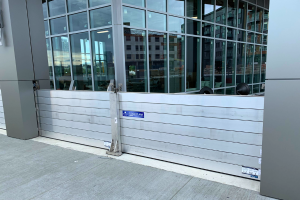
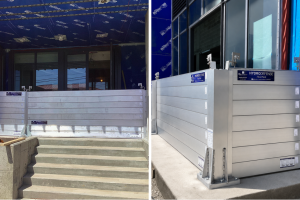
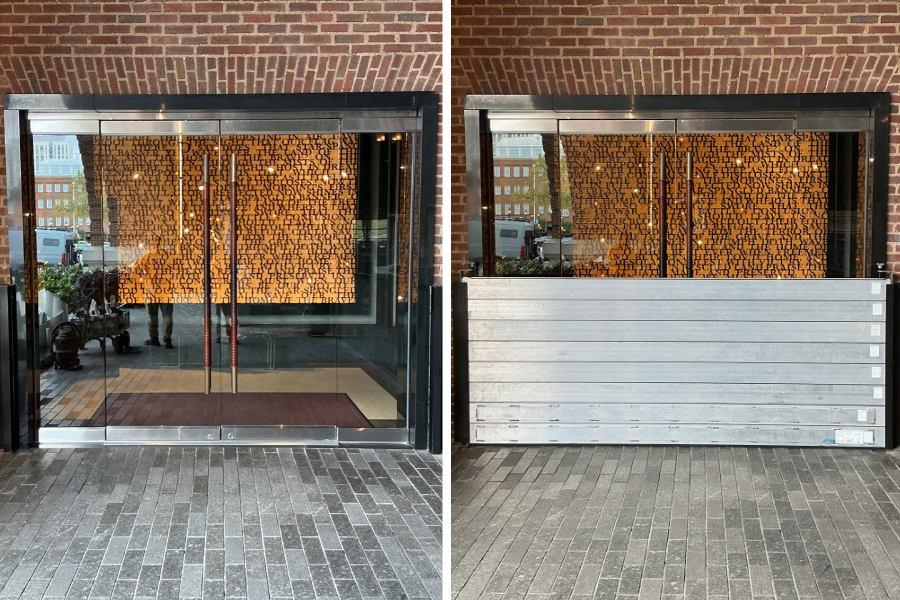
Control risks, minimize damage, and enable continuity with removable flood barriers. These solutions are engineered for high resilience levels & protection capabilities – comparable to always-in-place, passive systems. However, flood planks are uniquely fully-removable when storm risks are not imminent – preserving architectural aesthetics & design integrity. With stackable deployment capabilities, your system can support a range of vertical and horizontal configurations – reaching 13’+ water protection heights. Enable simple, straightforward, and rapid deployment with stackable flood barriers.
Water Diversion Walls
Integrate heavy-duty water diversion & mitigation walls to defend against flash flooding, heavy rains, and severe natural disasters. These innovative systems use hydrostatic pressure to create support & maximize integrity. This creates a watertight seal that minimizes possible seepage or leakage – keeping your critical assets dry & protected.
Implement solutions for a diverse range of infrastructure applications & use cases:
- Main Building Entrances
- Loading Docks & Warehouses
- Building & Property Perimeters
- Public Transit Stations & Networks
- Museums & Historical Sites
- Data, Server, & Technology Centers
- Municipal & Government Buildings
- Airports & Transportation Hubs
- Event Venus & Public Attractions
- Recreational Parks & Spaces
Strengthen your emergency response & preparedness plan with versatile, reliable, and durable solutions. Secure your facility, operations, personnel, and equipment with water diversion barriers.
Perimeter Barrier Systems
Protect extended openings, extra-wide runs, and full properties with perimeter flood mitigation systems. If your full building perimeter, retail storefront, parking lot entrance, or construction site is vulnerable – these systems offer a scalable solution. Devices can be interconnected or custom-fabricated to support your risk tolerance & defense requirements. For comprehensive protection, integrate systems that enable seamless automatic deployment, uninterrupted defense, and durable storm mitigation design. Replace multiple devices & moving parts with a heavy-duty, resilient solution.
Defend your facility, operations, and team with flood control & mitigation barriers. Prioritize automatic & passive options – which remain always-in-place, around-the-clock, 24/7/365. Consider systems that are approved and compliant with nationwide FEMA standards. For extended protection, consider full water diversion walls or perimeter-length gates. Additionally, stackable stop logs enable rapid deployment – when advanced storm notice is issued. Before integrating watertight solutions, take time to determine flood mitigation risk tolerance. Follow the points above to learn about flood mitigation barriers to control, prevent, and eliminate risk.