
Compare flood-resistant building codes for safe & resilient commercial properties. Nationwide US properties need to meet specific design, construction, and maintenance requirements. These standards are managed by the Federal Emergency Management Agency (FEMA), National Flood Insurance Program (NFIP), as well as local authorities. As a building owner, stay updated with the latest compliance guidelines for natural disaster & emergency management.
Before you schedule an on-site risk assessment, familiarize yourself with the latest International (I-Codes):
- International Building Code (BC / IBC): Baseline for commercial, industrial, and multi-family property design. Establishes key standards for life safety & structural strength.
- Performance Codes (ICC): Sets measurable performance goals for design professionals and engineers.
- Existing Building Code (IEBC): Requirements for repairs, upgrades, additions, and alterations on existing facilities. Across the country, cities have individual standards & approvals, including the NYC Existing Building Code.
- Mechanical Code (IMC): Guidelines for water supply equipment, plumbing utilities, and core control systems.
- Fire Code (IFC): Specifications covering emergency access, hazardous material management, and fire preparedness.
Read on to learn about installing protection that’s compliant with local, statewide, and federal flood resiliency building codes.
National Flood Insurance Program (NFIP)
Explore up-to-date building codes & standards with the National Flood Insurance Program. The NFIP provides accessible coverage for building owners, businesses, and US communities. Adopt & adhere to local floodplain management regulations with specialized insurance policies in-place. Typically, both building & contents coverage policy options are available for owners. In the event of a severe storm or natural disaster, NFIP policies cover physical losses to resilient infrastructure, assets, and equipment. Before recommending an approach, teams review property value/age, coverage scope, type of industry, and unique site-specific requirements.
Minimum floodplain management standards to qualify for the NFIP program traditionally include:
- Flood Resistant-Construction: Materials & equipment must be flood damage resistant for reliable protection.
- Openings & Enclosures: Subterranean basement spaces need dedicated hydrostatic openings or vents.
- Elevation: The lowest level of your property must be at or above base flood elevation (BFE). This represents the annual 1% change of flooding.
- Anchoring: Your structure needs to be securely constructed to prevent collapse, movement, or floatation during high-water events.
- Local Rules: Many municipalities & cities enforce stricter rules, extra freeboard height, and added BFE requirements.
Speak with mitigation specialists about current NFIP requirements & standards before the start of your flood resilient architecture projects.
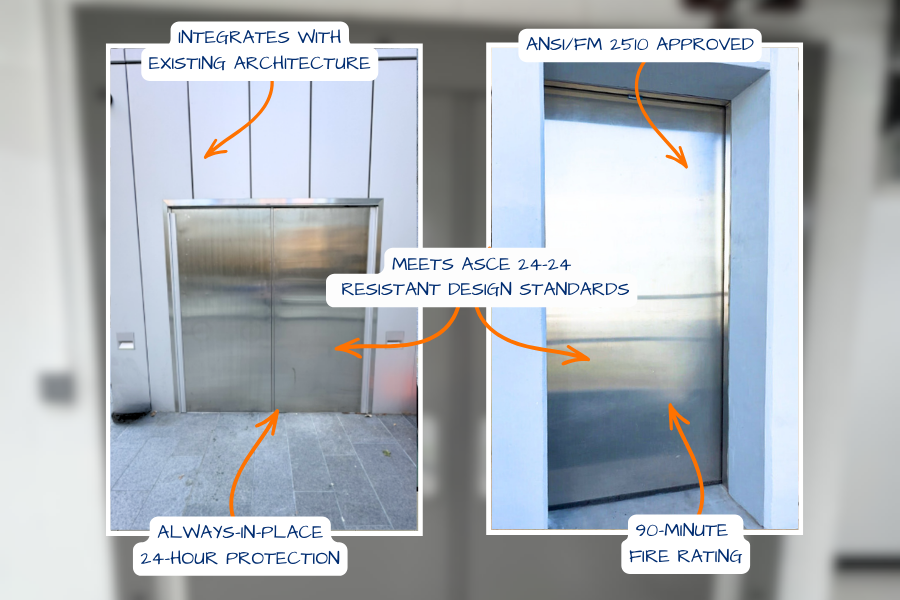
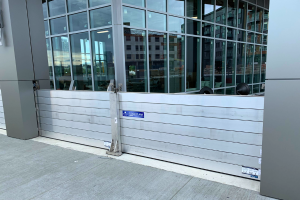
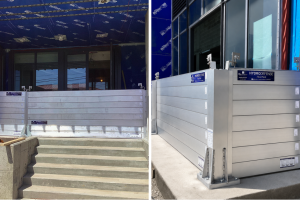
Single & Paired Flood Doors Installed By Orange Flood Control, LLC At The World Trade Center In Lower Manhattan, NYC. ANSI/FM Approvals 2510, 90-Minute UL 10C Fire-Rating, ADA Compliant.
ASCE 24 Flood Design Classes
ASCE 24 sets minimum flood resistant design & construction standards for properties in special flood hazard areas. The American Society Of Civil Engineers (ASCE) is an ANSI-accredited SDO. Across the county, ASCE requirements provide technical guidelines that enforce efficiency, dependability, productivity, and safety. These benchmarks are a consistent reference for design professionals, architects, and civil/structural engineers. Access risk-focused needs for coastal, waterfront, and urban properties.
The latest ASCE 24-24 design criteria addresses foundation construction, elevation, floodproofing strategy, and utility criteria. Recent updates & clarifications include:
- Inspection & Maintenance Requirements For Flood Mitigation Plans
- Flood Hazard Area Extended To The 500-Year Floodplain
- Changes For Alignment With ASCE/SEI 7-22
- Placement Of Automatic Control Valves, Attendant Utilities, & Dedicated Equipment
- Design Class Changes For Hospitals, Ambulatory Care, & Agricultural Operations
Review criteria to achieve and maintain compliance with the American Society of Civil Engineers & Structural Engineering Institute.
ASCE 24 Freeboard Requirements Across United States Cities
Across the United States, the American Society of Civil Engineers codes require specialized building elevation or construction improvements based on a property’s design flood elevation (DFE). These requirements ensure facilities meet or exceed National Flood Insurance (NFIP) guidelines. Nationwide cities have specific provisions that apply to new construction projects & substantial improvements to existing buildings.
- San Francisco Building Code ASCE 24 Freeboard Requirements
- New York City Appendix G Freeboard Standards
- New Jersey Flood Hazard Area Rules and REAL Elevations
- Florida Building Code Flood Provisions & Product Approvals
- California Title 24 Freeboard Amendments
- Houston and Harris County 500-Year Floodplain Rules
- Boston Coastal Flood Resilience Overlay District
Orange Flood Control, LLC is available to help you align design & compliance throughout the planning phase. Address site-specific standards, risks, and vulnerabilities with internal architectural support. Before devices are recommended, determine the local, state, and federal compliance standards that apply to your project.
ANSI/FM 2510 Testing & Certification Standards
ANSI/FM 2510 remains one of the most well-known flood protection codes, focused on testing & certification standards. This national US standard sets key testing performance requirements for watertight mitigation barriers, designed to protect against coastal/tidal or riverine/flash flooding risks.
As you compare FM approved barriers & develop your strategy, review general requirements from the American National Standards Institute (ANSI) & Factory Mutual Global:
- Barrier Components Must Be Corrosion-Resistant
- Glazing Products Must Be Fabricated With Laminated Glass
- Automatic Barriers Should Be Designed For Debris Resistance & Impacts
- Manually-Operated Mechanisms Need To Have A Locking/Latching Component
- Self-Activating Equipment Needs To Have Manual Deployment Options
Exact requirements depend on your system’s permanent/removable functionality, active/manual operations, or intended applications. Additionally, there are specialized parameters for opening/perimeter barriers, resistant glazing, and flood mitigation pumps. Evaluate testing & certification parameters for flood resilient building codes.
FEMA Special Flood Hazard Areas Codes
FEMA special flood hazard areas (SFHAs) have unique requirements & protocols for compliance. These requirements determine construction restrictions, floodplain management regulations, and policy eligibility.
Start by determining your building’s zone definition & risk classification level:
- A: High-risk zone with no BFE.
- AE: High flood risk area with a documented & established BFE.
- AO: At-risk of shallow, sheet flow flooding.
- AH: Risks associated with shallow pond locations & documented BFE data.
- V: Coastal area with high wave impact risks.
- VE: Similar to Zone V, with a documented hydraulic analysis & base flood elevation.
- X: Outside FEMA’s 1% annual floodplain map. Insurance is recommended but not required.
- D: No analysis performed, but higher risk levels expected. Coverage or protection may be advised.
Whether you’re located in an SFHA or proactively planning for the future, meet with flood control experts to measure your site’s risk. Evaluate zone designation, BFE data, and recommended options. Speak with flood mitigation companies to understand building, testing, inspection, and maintenance codes in FEMA SFHA zones. Then, compare FEMA compliant flood barriers that align with your facility’s operating requirements & risk tolerance.
British BS 851188 Certification Standards
For projects that must meet strict United Kingdom compliance standards, carefully review the BS 851188. These codes are traditionally managed through the British Standards Institute (BSI), which serves as the UK’s National Standards Body. The BSI covers technical standards, certification, and code-related business support. Before certification, products need to be tested at a recognized BSI facility to simulate real-world flooding conditions. This in-depth process provides valuable confidence, peace of mind, and reassurance for project stakeholders.
Here’s a summary of the British certification standards:
- Testing: Measure performance against hydrostatic water pressure & dynamic wave impacts.
- Leakage Limits: Meet strict threshold limits on a per minute or per hour basis.
- Documentation: Results organized in installation manuals, guide, and quality control (QC) reports.
Compared to the United States’ ANSI/FM 2510, BSI standards emphasize leakage testing, O&M, and fabrication. Unlike FM Approvals, BS 851188 does not cover testing and longevity. Overall, US standards concentrate more on usability, impact/wear resistance, and annual maintenance verification. Compare UK BS 851188 stands vs traditional United States hazard mitigation building codes.
Wet vs Dry Floodproofing Requirements & Mandates
Before you select code-compliant mitigation systems, compare wet vs dry floodproofing mandates for commercial buildings & continuous critical infrastructure operations. Dry floodproofing measures aim to make vulnerable openings fully watertight & impermeable against expected hydrodynamic loads. To completely block out water, these measures involve installing permanent, self-deploying, or removable barrier systems. There’s specific requirements, standards, and limitations outlined in ASCE 24 & FEMA 3-93.
Wet floodproofing methods emphasize damage-resistant construction & resilient materials that allow at-risk areas to safely and intentionally flood. This approach may be recommended for crawlspaces, basements, and properties below base flood elevation (BFE). To satisfy National Flood Insurance Program (NFIP) mandates, these projects need to be strictly passive or automatic with no required human involvement.
For more clarity around the right method & approach, schedule an on-site risk assessment with Orange Flood Control, LLC. Our solution-driven team can help you coordinate your strategy & design to align FEMA, ASCE, and FM2510 requirements.
Project Compliance Checklist
Develop a site-specific compliance checklist for storm & hurricane resistant projects. To determine code requirements, you need to first measure current & expected future flooding risk. Identify the type of flooding event, average advanced storm notice, 24/7 staffing levels, property value, and facility use. Think about how much risk your facility, stakeholders, and business is actually willing to tolerate. There’s additional considerations for properties within the mapped floodplain, including coastal communities, waterfront urban cities, and FEMA special flood hazard areas (SFHAs).
Depending on your property’s number of openings, daily operations, and FEMA flood zone classification, your checklist may include:
- Verify Base & Design Flood Elevation (BFE / DFE)
- Confirm New Construction Or Existing Improvements
- Identify At-Risk Utility Support Systems (Electric, Plumbing, HVAC, Mechanical Controls)
- Determine Enclosed Spaces Below DFE (Basements, Stairwells, Parking Garages, & Storage Rooms)
- Validate FEMA Flood Zone (A, AE, AH, AO, AR, A99, A1-A30)
- Check For Special Classifications – Special Flood Hazard Area (SFHA) or Coastal Barrier Resources Area (CoBRA)
When you’re planning a project that requires insurance approvals, building code inspections, and federal compliance – partner with firms that specialize in full-lifecycle, complete flood protection. Orange Flood Control, LLC works with authorized device distributors, factory-trained installers, and OSHA-certified personnel to keep compliant projects on-time, on-budget, & standards-aligned.

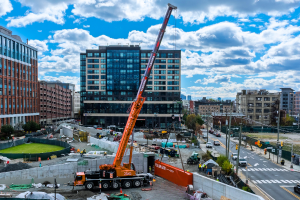
Flood Control Project Inspection & Assessment At Citi Field In Queens, NYC.
How Orange Flood Control, LLC Supports Code-Compliant Projects
Orange Flood Control, LLC supports business owners, design professionals, engineers, and contractors throughout code-compliant mitigation projects. Our specialized company understands the entire flood protection lifecycle from early planning to long-term, ongoing preparation. From your initial architect-led consultation to annual maintenance, the approach is solution-driven, coordinated, and precise. We understand that strengthening flood resistant buildings is more than just installing doors, stop logs, glass, and devices. Our entire team is committed to educating key project stakeholders with product selection insights, multi-trade collaboration, and a deep knowledge of industry regulations.
Here’s what the end-to-end process looks like with our team of flood experts:
- Design: Custom protection starts with internal architectural support, project management, and documentation coordination.
- Consulting: Support for project-specific risk assessments and device selection.
- Compliance: Expertise in ANSI/FM 2510, ASCE 24-24, NYC EBC, FEMA, and BABA protection standards – as well as the insurance impacts and required inspections.
- Supply: Quality systems from established, authorized, and approved manufacturers. Fabrication, delivery logistics, and job-site tracking is all coordinated in-house.
- Coordination: Streamline pre-installation requirements, heavy equipment plans, and device mobilization.
- Installation: Union-certified millwright technicians keep projects on-schedule and on-budget from embed placement to compliance water testing.
- Testing: Fit, light, hose, chalk, and field hydrostatic water testing. Teams verify seals, document performance, and validate code requirements.
- Maintenance: Yearly, schedule thorough inspections and components repairs/replacement with real-time field activity documentation.
- Training: Keep new staff empowered & retrained with comprehensive presentations, step-by-step instructions, and deployment videos.
Once you’re ready to start planning, reach out to our full-lifecycle, solution-driven team to schedule an initial consultation & on-site risk assessment.