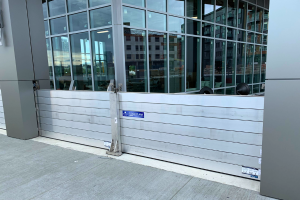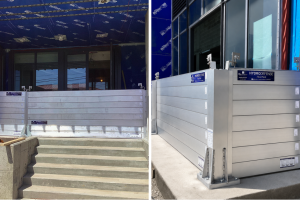

Compare resilient flood protection use cases for buildings & US infrastructure. Heavy-duty flood protection devices are customized to nationwide building operational, compliance, resiliency, and continuity requirements. These systems are engineered to keep facilities safe during heavy rainfall, hurricanes, high-wind conditions, overwhelmed drainage systems, and flooding natural disasters. As a building owner, coordinate with the best flood protection companies to strengthen site-wide resiliency with options that are:
- FEMA Compliant
- Insurance Industry Approved
- Marine-Grade & Corrosion-Resistant
- Rapidly Or Automatically Deployed
Read on to learn about resilient flood protection for United States buildings and infrastructure.
Flood Mitigation For Commercial Buildings & Business Facilities
Integrate commercial flood protection to secure your business operations, workspaces, equipment, utilities, and facilities. Design protection to safeguard your business’s control systems, stock/inventory, operational equipment, personnel workspaces, and daily processes. Start with vulnerable openings, entrances, access points – or consider your property’s full perimeter. Resiliency upgrades are critical for commercial businesses in high-ticket industries – including currencies, precious metals, automotive/vehicles, and artwork.
Here’s a range of versatile, resilient, and reliable options for commercial building defense:
- Flood Protection Barriers For Businesses
- Passive Flood Protection Systems
- Automatic Flood Protection Design
- Flood Protection Doors
- Storm Surge Protection Barriers
Integrate flood protection for commercial buildings, business facilities, industrial warehouses/factories, and retail locations.
Flood Damage Protection For Existing Buildings & New Construction Projects
Flood protection services are customized for new & existing buildings across the United States. In early planning stages, new construction projects have a range of options – including wet/dry floodproofing projects, active barriers, and integrated design. For existing facilities, consult with architect-led flood protection companies to assess vulnerable openings, structural integrity, and project options.
Meet with building flood protection companies for specialized information, guidance, consulting, and resources:
- Floodproofing Data Sheets
- Flood Resilience Planning Guides
- Flood Mitigation Resilience Plan
- Hazard Mitigation Plan Updates
- Flood Emergency Response Plans
For New York City projects, coordinate with turnkey resiliency management companies experienced in the latest NYC Existing Building Code (EBC) updates. To get started today, perform a comprehensive corporate flood risk assessment for new & existing construction projects. Evaluate resilient flood protection for new and existing buildings.
Flood Control For Multi-Family Residential Properties & Communities
Across the United States, multi-family properties, developments, high-rises, and communities are integrating building flood protection. Multi-family buildings need protection that’s rapidly-deployable, highly-effective, and reliable under real-world conditions. Systems may be recommended for multi-level/subterranean parking garages, stairwells, basement walls, control systems, and window wells.
During your initial risk management consultation, get answers to the most common frequently asked questions (FAQs) for multi-family flood control:
- What Are The Best Flood Barriers For Multi-Family Communities?
- Should I Consider Sandbag Alternatives?
- How To Protect My Tenants, Utilities, Project, & Full Development?
- Do Barriers Require Customization For My Property?
- How Quickly Can Devices Be Activated & Deployed?
Consider flood protection for multi-family buildings, assets, and tenant homes.
Flood Risk Action Plans For Urban Waterfront & Coastal Buildings
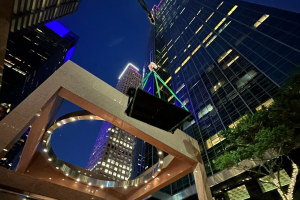
Analyze use cases for flood protection for coastal, waterfront, and urban buildings. These high-risk buildings – including schools, businesses, retail stores, and medical centers – have unique flood protection challenges & requirements. These projects require precise coordination to address risks for surrounding urban streets, electrical/pump substations, and public transit networks. Expert teams recommend solutions that protect community architecture & design aesthetics – without sacrificing long-term protection. Flood protection is a priority for nationwide US cities:
- New Jersey: Jersey City, Bergen County, Little Ferry
- New York: Manhattan, Brooklyn, Queens, The Bronx, Upstate NYC
- Florida: Naples, Miami, Naples, Tampa Bay
- Massachusetts: Boston, Cape Cod, Barnstable
- Louisiana: New Orleans, Baton Rouge, Lafayette
- Georgia: Atlanta, Savannah, Brunswick
- Mississippi: Biloxi, Gulfport, Jackson
- North Carolina: New Bern, Wilmington, Raleigh
Design flood protection for waterfront and urban buildings across the United States.
Flood Proof Utility Sites & Wastewater Treatment Plants (WWTPs)
Support resiliency, continuity, and uptime with flood protection for wastewater treatment plant buildings. Utility site flood control requires careful coordination with WWTP directors, program leaders, design professionals, engineers, contractors, and citywide planners. US resiliency companies understand the requirements to defend facilities that can’t afford downtime – including unmanned facilities, secure sites, and remote WWTP locations.
In addition to wastewater treatment plant protection, systems & solutions are installed to support a range of critical infrastructure sectors:
- Flood Protection For Transit Systems
- Critical Manufacturing & Communications
- Medical Centers, Hospitals, & Public Health
- Information Technology & Cybersecurity
- Emergency & Government Services
- Nuclear, Chemical, & Energy Sector
- Levees & Dams
Install flood protection for doors, windows, and vulnerable access points at US WWTP facilities.
Here’s how to get started & potentially reduce flood risk:
- Review Current Protection (Preventative Measures, Sump Pumps, Equipment To Prevent Damage)
- Assess Your Type Of Flood Event (Severe Storms, Climate Change, Overwhelmed Storm Drains)
- Establish Requirements For Flood Prone Areas & Commercial Properties
- Compare Device Options (Flood Walls & Custom Mitigation Options)
- Design Customizable Flood Protection Solutions
- Coordinate Professional Installation With Contractors & Local Officials
- Review Available Financial Assistance & Floodplain Management Ordinances
- Address National Flood Insurance Program (NFIP) Requirements
- Determine Ways To Lower Flood Insurance Premiums