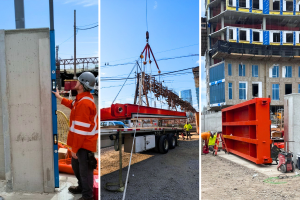


Review passive flood protection system requirements, standards, guidelines, and specifications for United States commercial infrastructure. Passively-activated flood protection barriers automatically raise without human intervention, electricity, warning systems, or pre-storm preparation. The result, 24/7/365, always-in-place protection whenever floodwaters rise. As a building owner yourself, prioritize passive & automatic deployment systems to maintain regulatory compliance, normal operations, and facility resilience.
The impact of passive & automatic flood barriers:
- No People/Power Or Electricity Needed
- Always Ready Defense
- High Aesthetic & Functional
- Minimal Annual Maintenance
- Versatile Use Cases
- Cost Efficiency For Long-Term Use
- No Pre-Storm Transport Required
- Eliminate Gaps To Prevent Damage
- Maintain Normal Daily Operations
- Easily Combined With Multiple Measures
- Tested For Nationwide Standards
- Address Multiple Levels Of Flood Risk
- Creates A Resilient Watertight Barrier
Read on to learn about US passive flood mitigation standards and requirements.
Self-Deploy With No Human Intervention, Storage, Or Manpower
Passive flood barriers are engineered for automatic, self-deployment – forming a watertight seal with no human intervention or emergency planning requirements. Compared to active systems & active measures, these products deploy using rising water levels – them retract to the resting position once floodwater recedes. These capabilities avoid relying on manual labor – which is prone to unavailability or human error. When not in-use, systems integrate with existing architecture & infrastructure to remain nearly invisible. There’s no off-site storage, transportation, or inspection needed to keep your property protected. Choose self-activating flood barriers to maintain access, protect your personnel, and avoid operational disruption.
Self Closing Flood Barrier Solutions Support Versatile Common Applications
Compare the common use cases & building applications for passive flood device solutions. Passive equipment provides permanent defense for commercial buildings & critical infrastructure facilities nationwide. Flood control companies work with properties that have experienced substantial damaged, considered relocation, or temporarily closed because of flooding.
Primary building applications include:
- Building Entrances & Openings
- Underground Basements & Stairwells
- HVAC, Electrical, Mechanical, & Utility Rooms
- Coastal, Waterfront, & Riverside Defense
- Roadways, Highways, & Railways
- Pedestrian Doors & Vehicle Entrances
- Loading Docks For Retail, Commercial, & Multi-Family
- Elevator Cores & Critical Operational Systems
- Power Stations & Utility Plants
- Communication Centers & Government Facilities
Passive flood protection solutions meet requirements for versatile applications & use cases.
Provide Passive Flood Protection For Different Types Of Flood Risk
Passive flood barriers provide reliable, watertight, and impermeable defense for a range of flooding risks. While aligning with FEMA, Florida product approval, ANSI/FM 2510, ASCE 24-24, and BABA flood protection standards – these products are trusted to address a range of flood risk conditions & natural disasters:
- Flash Flooding
- Urban Floods
- River & Coastal Flooding
- Pluvial Flooding (Surface Water)
- Ground Water Flooding
- Dam, Levee, System Failure
- Rapid Snowmelt & Ice/Debris Jambs
- Heavy Rainfall
Systems are engineered to address approaching floodwaters for a range of facility, site, access, cost, and flood risk requirements.
Passive Flood Barrier Systems For Always-In-Place, Hands-Free Defense
Passively-activated flood protection is a reliable solution for always-in-place, hands-free defense. When it comes to protecting your property, operations, and personnel – you need solutions that you can trust around-the-clock. Every moment counts in these situations – you can’t risk investing in devices that may fail. Eliminate the time-consuming, labor-intensive procedures to retrieve equipment from storage, setup flooding devices, and conduct a final inspection.
How passive windows and flood doors work:
- Activation: Water is filled into an underground basin or pit. Air is displaced, compartments are filled, float pistons automatically rise – lifting the barrier into place.
- Watertight Sealing: Fully-raised, angled support arms lock & seal flood panels or gates in place.
- Deactivation: Water recedes – pump mechanisms lower your passive flood barrier into the recessed position.
With passively-deployed flood barriers, you have the confidence & peace of mind knowing that your property is defended 24/7/365 – even when its unmanned.
Specifications For Flood Barriers, Flood Doors, & Passive Systems
Review individual specifications for flood barriers, flood logs, panels, and other flood mitigation devices. Developing an automated approach to prevent flooding may take a level of customization, planning, and expertise. Multiple flood barriers may be combined to create a facility-wide, perimeter protection system – without relying on human or electrical power.
Speak with an architect-led company to review specs for:
- Project-Specific Design & Customization
- Construction, Installation, & Materials
- Performance Standards & Hydrostatic Testing
- Velocity, Impact, & Fire Rating
- Water Depth & Protection Heights
- Flood Barriers & Site Placement
- General Specifications
Compare specifications & measures for automatic flood barriers – rated for 24/7/365 defense.
Integrate passive flood barriers to defend your facility & personnel. Systems have unique specifications for design, customization, cost, testing, and annual maintenance. For guidance throughout the process, collaborate with a team of expert architects, engineers, and design professionals. Follow the points above to learn about standards for passively-deployed flood walls and devices.